
Aging research has shifted in the last decade from treating individual symptoms to studying the cellular machinery underneath them. Energy production slows. DNA repair gets sloppier. The protective caps on our chromosomes wear down. Three of the most studied compounds in this space each target a different part of that decline, which is why NAD+, Epitalon, and MOTS-c keep coming up together in longevity conversations.
This guide breaks down what each one does, the research behind it, and where the honest limits of that research sit. None of these is a miracle compound, and the science is clearer in some places than others.
NAD+: The Cellular Energy Coenzyme
NAD+ is worth a quick clarification up front. It is not a peptide in the strict sense. It is a coenzyme, nicotinamide adenine dinucleotide, found in every living cell, and it usually gets grouped with longevity compounds because of the role it plays in aging. That role is large.
NAD+ works as an electron carrier in the reactions that turn food into usable energy, including glycolysis, the Krebs cycle, and oxidative phosphorylation. Without enough of it, the cell’s energy production stutters. It also serves as fuel for two important families of enzymes: the sirtuins, which are tied to cellular repair and longevity signaling, and the PARPs, which handle DNA repair.
The problem is that NAD+ levels fall as we age. Research points to two reasons working in tandem: stress-response enzymes like CD38 and the PARPs consume more of it over time, while the cell’s own salvage pathway produces less. Studies in animal models have linked restoring NAD+ to better mitochondrial function, improved DNA repair, and extended healthspan. Most of that evidence comes from preclinical work rather than large human trials, so the picture is promising rather than settled.
You can find NAD+ in the anti-aging range, where it tends to be of interest to people studying cellular energy and metabolic resilience.
Epitalon: The Telomere Peptide
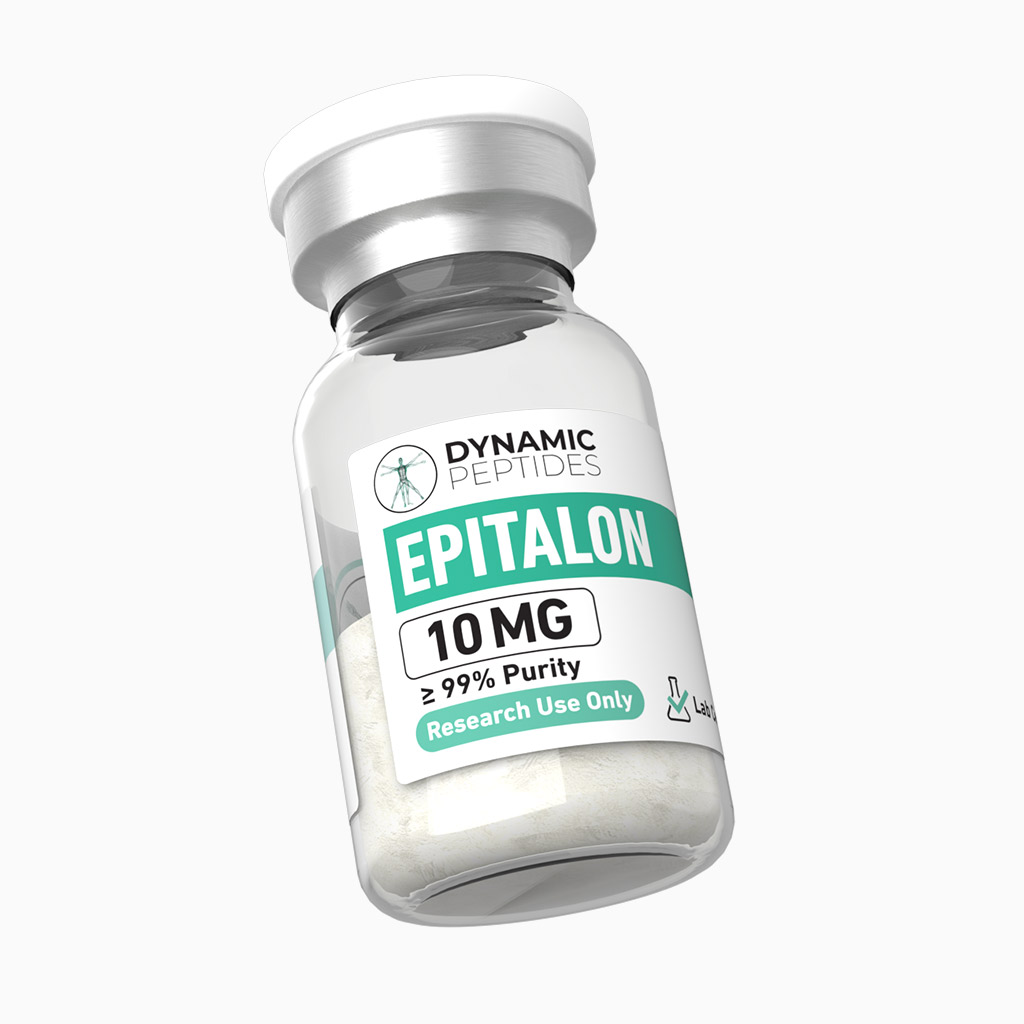
Epitalon is an actual peptide, and a small one. It is a tetrapeptide, four amino acids in sequence (Ala-Glu-Asp-Gly), synthesized to replicate the active part of epithalamin, a natural extract from the pineal gland. Russian gerontologist Vladimir Khavinson and his team at the St. Petersburg Institute of Bioregulation and Gerontology first developed it in the 1980s, and they have produced decades of research on it since.
Its headline mechanism is telomerase activation. Telomeres are the protective caps on the ends of chromosomes, and they shorten a little with every cell division until the cell can no longer divide safely. Epitalon appears to upregulate telomerase, the enzyme that maintains those caps. In human cell cultures, it has been shown to lengthen telomeres and let cells divide past their normal limit. In animal studies, it extended lifespan in flies and rats and reduced age-related chromosomal abnormalities in mice.
There is a second mechanism worth knowing about. Because Epitalon traces back to the pineal gland, research suggests it helps restore that gland’s melatonin production, which governs sleep and circadian rhythm and tends to decline with age. Some studies also point to antioxidant effects.
The honest caveat: most of the strong telomerase evidence comes from cell cultures and animal models. Whether those effects translate to meaningful telomere extension in living humans at practical doses is still an open question. The research is real and spans three decades, but it is not the same as a finished human clinical case. Epitalon sits in the longevity range for exactly this reason: it is a research compound, studied seriously, with results that are compelling but incomplete.
MOTS-c: The Exercise Mimetic
MOTS-c is the newest of the three and arguably the most interesting from a biology standpoint. It is a 16-amino-acid peptide, and unlike almost every other signaling peptide, it is encoded in mitochondrial DNA rather than in the cell’s nucleus. That discovery, formally characterized in 2015, reframed mitochondria as active communicators rather than passive energy factories.
What MOTS-c does is activate AMPK, the master energy-sensing pathway that physical activity also switches on. Through that pathway it enhances glucose uptake, increases fat oxidation, and supports mitochondrial biogenesis. Your skeletal muscle releases MOTS-c during exercise, fasting, and energy depletion. One study measured a roughly twelve-fold rise in muscle MOTS-c levels after a single bout of exercise, which is where its nickname comes from.
That nickname, “exercise mimetic,” needs a careful read. In aged mice, MOTS-c treatment improved running endurance by around 20 percent and sharpened glucose tolerance and insulin sensitivity to levels closer to young animals. Those are striking results. There are also results in mice. The phrase “exercise mimetic” is useful shorthand for the pathways involved, but it is easy to misread as “replaces exercise,” and the evidence does not support that leap. Human clinical development of mitochondrial-derived peptides has been slow, partly because they have short half-lives and are hard to deliver.
For research purposes, MOTS-c comes in a few sizes depending on the scope of the work.
Where the Research Stands
Across all three, the same pattern holds. The cellular mechanisms are well described and genuinely interesting. The animal data is encouraging. The human data is thin, early, or absent. Anyone exploring these compounds should hold that distinction clearly: a strong mechanism and a strong animal result are not the same as a proven human outcome.
If you are working with any of these, accurate handling matters as much as the compound itself. Each ships as a freeze-dried powder that needs proper reconstitution, and the Peptide Mixing Calculator takes the guesswork out of getting the concentration right. The full anti-aging range covers these three plus related compounds like Semax and glutathione, and the FAQ answers most of the practical questions that come up before a first order.
All products sold by Dynamic Peptides are research-grade compounds supplied for laboratory and research purposes. They are not approved by Health Canada for therapeutic use, and individual responses to any biologically active compound vary. Anyone considering peptides as part of a personal protocol should consult a qualified healthcare professional, particularly where existing medical conditions or other medications are involved.